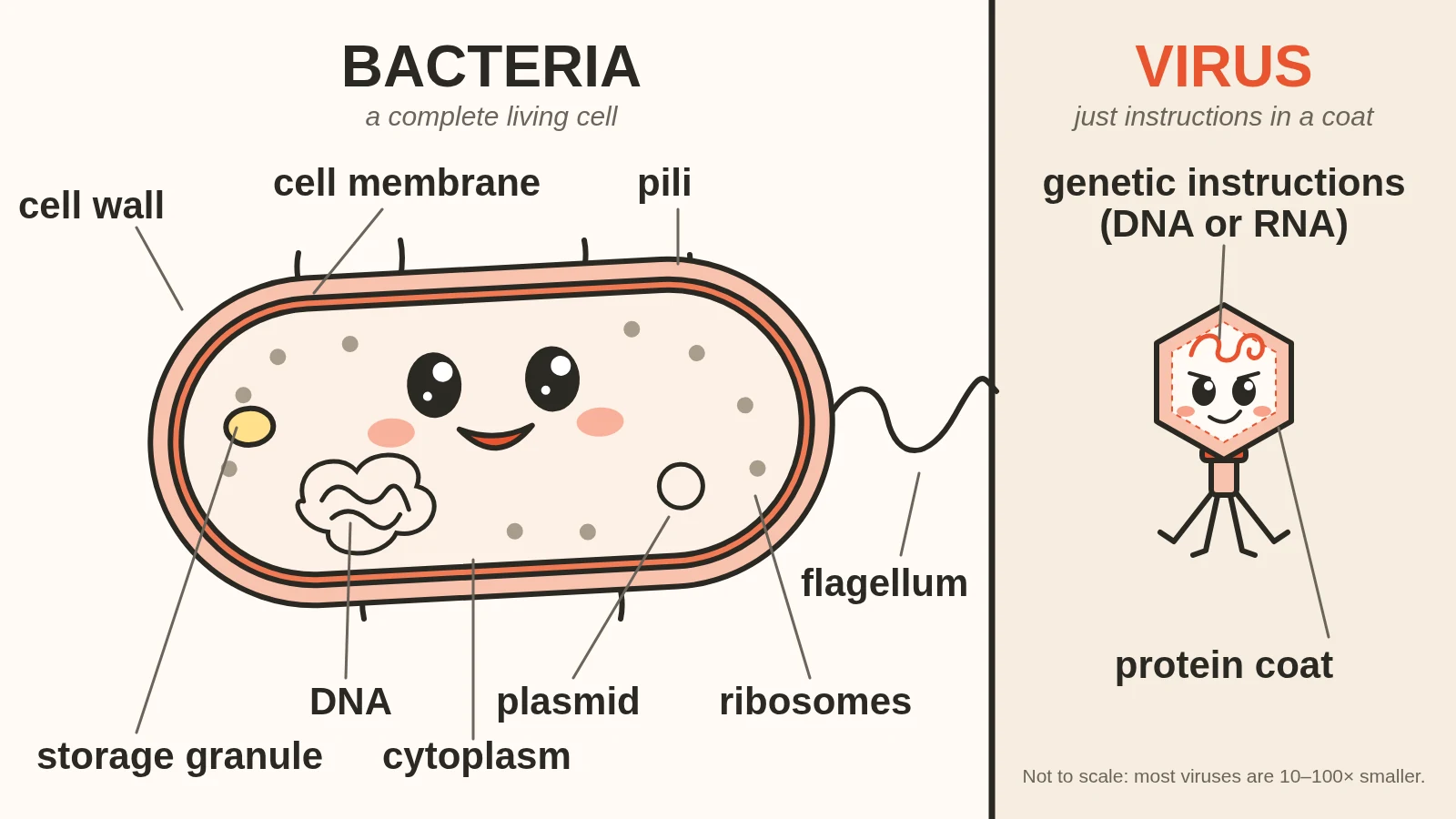
Both are tiny and both get called “germs,” but they live completely different lives.
Bacteria (bak-TEER-ee-uh) are living cells. Each one is a tiny camper that brings its own tent, stove, and food, so it can grow and split in two all by itself.1 Most are harmless, and many help. Your body carries roughly as many bacterial cells as human cells, about 38 trillion of them.2
Viruses are different. A virus is just a set of instructions (DNA or RNA) wrapped in a protein coat. It can’t copy itself alone. Like a sticky note slipped into a factory, it gets inside one of your cells and tricks it into making more viruses.3
That difference matters. Antibiotics work on certain bacteria, but they do not work on viruses like colds or flu.4
This week we’ll look at the bacteria living in your gut, ancient viruses tucked inside your DNA, and how the immune system changes as we age.
References
- MedlinePlus (U.S. National Library of Medicine), “Bacterial Infections”: https://medlineplus.gov/bacterialinfections.html
- Sender R, Fuchs S, Milo R. “Revised Estimates for the Number of Human and Bacteria Cells in the Body.” PLOS Biology 14(8): e1002533 (2016). doi:10.1371/journal.pbio.1002533
- MedlinePlus, “Viral Infections”: https://medlineplus.gov/viralinfections.html
- U.S. CDC, “Healthy Habits: Antibiotic Do’s and Don’ts”: https://www.cdc.gov/antibiotic-use/about/index.html
What this is not. Education only. Stories on cells.com are not medical advice. cells.com does not diagnose, treat, prescribe, run laboratory tests, or ship kits.
Simon Ng is the founder of cells.com. He has spent more than a decade on biotech finance executive teams, including at Quark Pharmaceuticals and Adverum Biosciences, and holds an MBA.