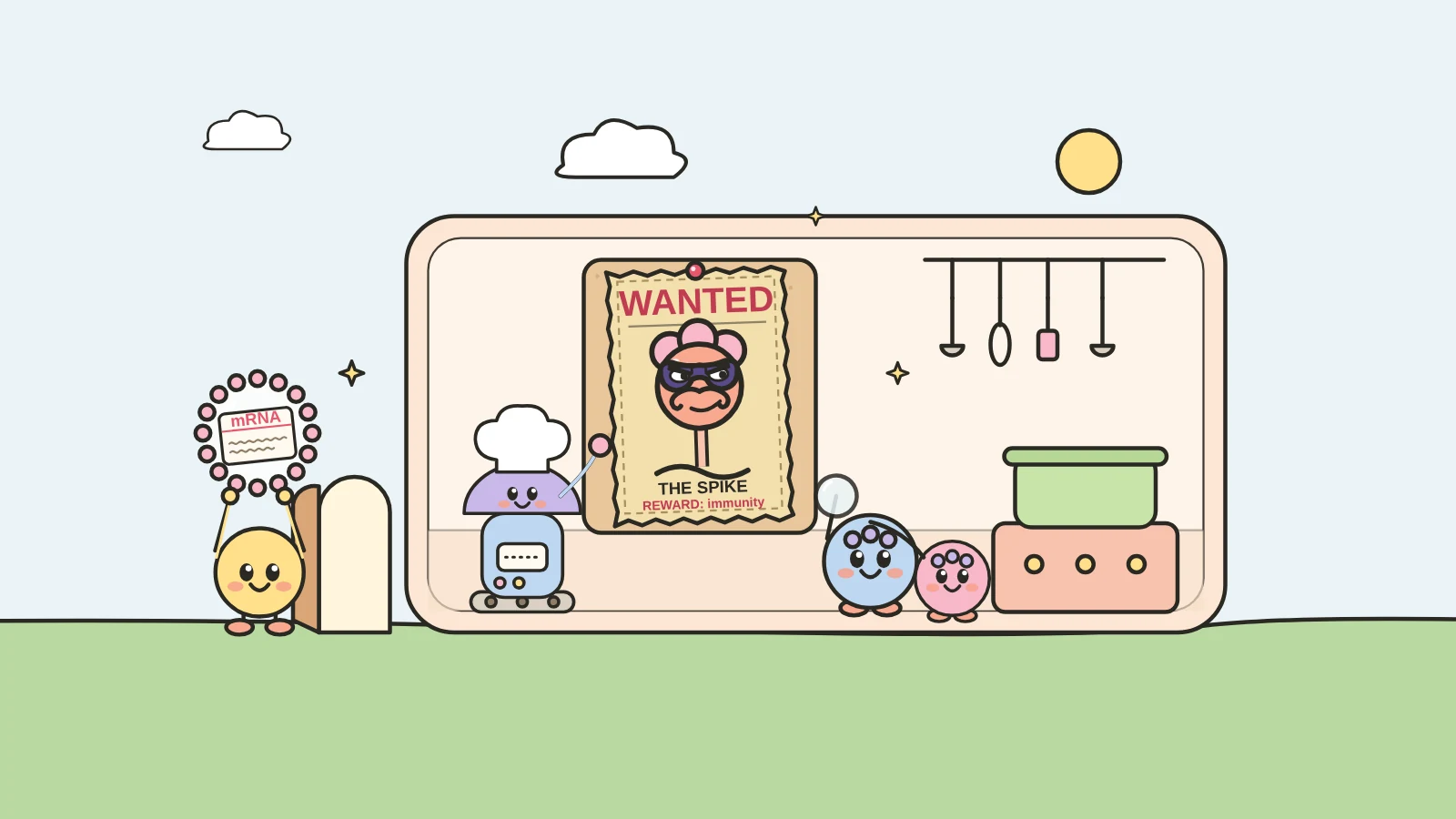
Borrow the recipe card, print a wanted poster, and let your body practice.
Yesterday we met mRNA (em-ARR-en-ay), the recipe card your cells cook from. Scientists asked: what if we slipped in a card of our own?
An mRNA vaccine carries a recipe for one harmless piece of a germ. For COVID-19 shots, that’s the spike protein, the knobby bit on the virus’s surface. The card rides inside a tiny bubble of fat called a lipid nanoparticle (LIP-id nan-oh-PAR-tih-kul).1
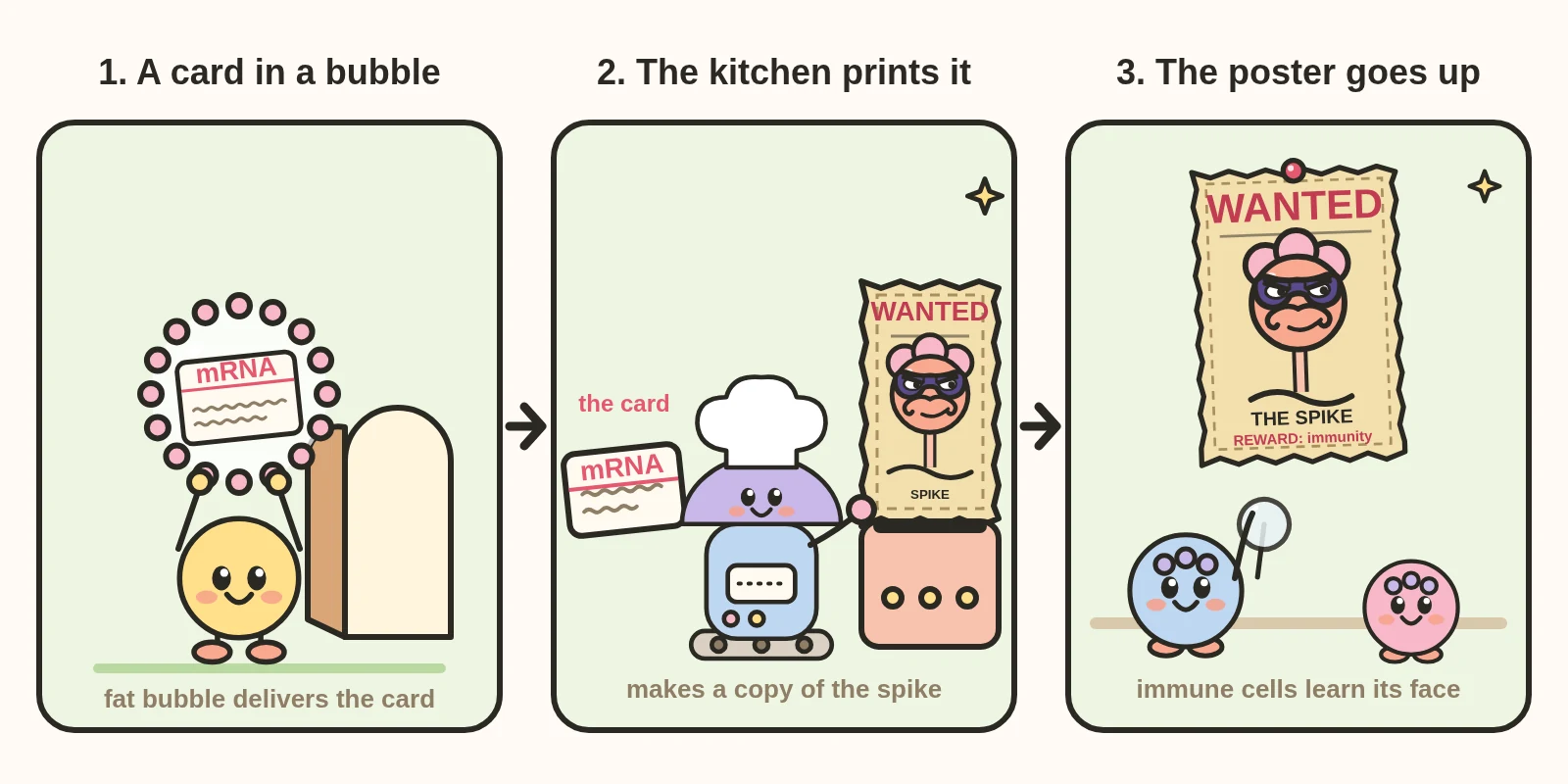
Your cells read the card and make the spike, like printing a wanted poster. Your immune system studies the poster and learns to spot the real virus later. The card never enters the nucleus (NOO-klee-us) and doesn’t change your DNA; cells break it down soon after.2
The trick that made this work was tweaking one mRNA letter so the body doesn’t attack the card itself. Katalin Karikó and Drew Weissman won the 2023 Nobel Prize for it.3
Tomorrow: can the same idea train the body against cancer?
References
- Hou X, Zaks T, Langer R, Dong Y. “Lipid nanoparticles for mRNA delivery.” Nature Reviews Materials 6:1078–1094 (2021). https://doi.org/10.1038/s41578-021-00358-0
- U.S. Centers for Disease Control and Prevention. “COVID-19 Vaccine Basics.” https://www.cdc.gov/covid/vaccines/how-they-work.html
- The Nobel Prize. “Press release: The Nobel Prize in Physiology or Medicine 2023.” https://www.nobelprize.org/prizes/medicine/2023/press-release/
What this is not. Education only. Stories on cells.com are not medical advice. cells.com does not diagnose, treat, prescribe, run laboratory tests, or ship kits.
Simon Ng is the founder of cells.com. He has spent more than a decade on biotech finance executive teams, including at Quark Pharmaceuticals and Adverum Biosciences, and holds an MBA.