Your body’s security team changes with age. Here’s how.
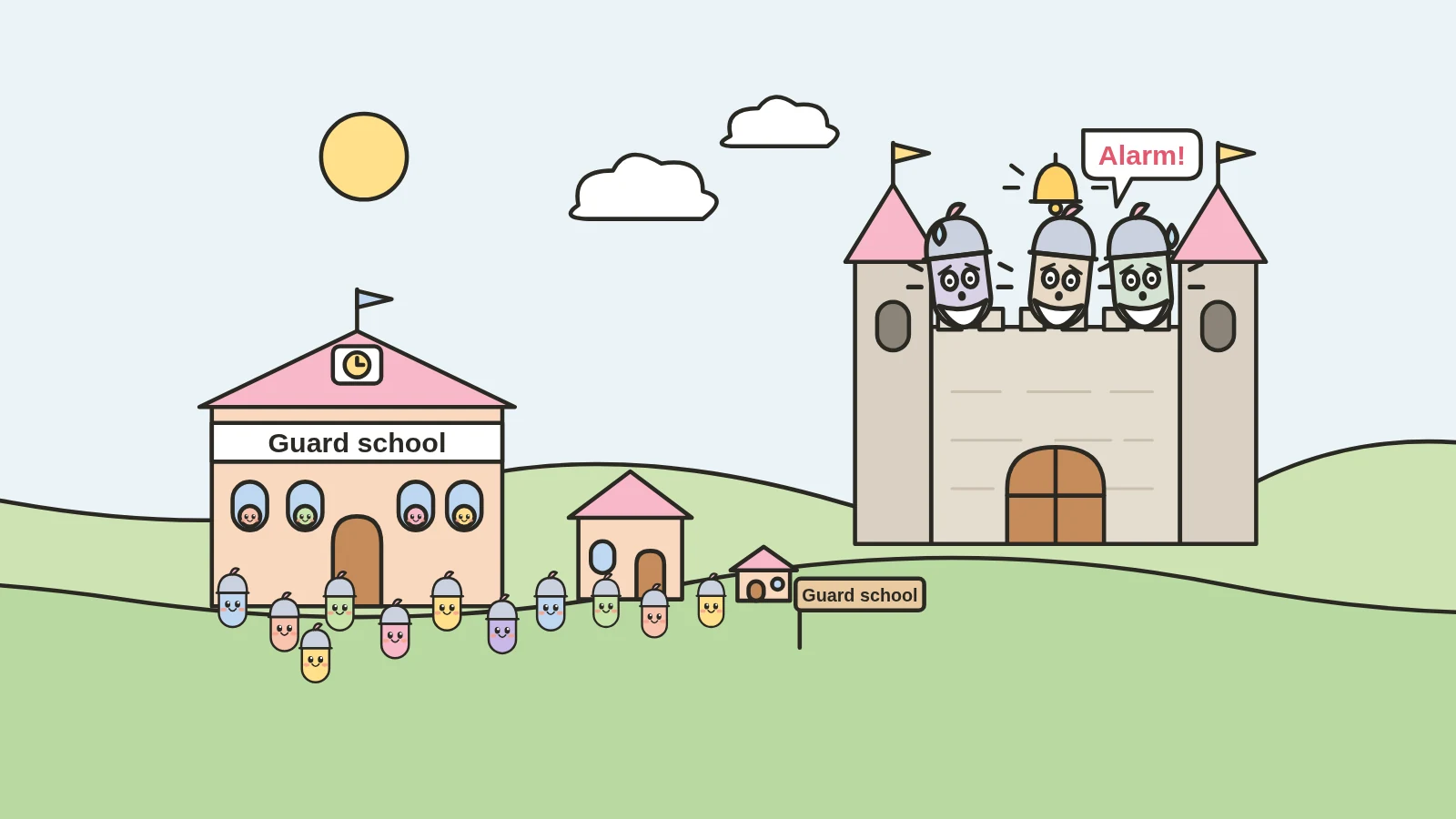
Think of your immune system as the security team guarding a castle. It spots germs, sounds the alarm, and sends guards to fight.
The team trains new recruits in a small organ behind your breastbone called the thymus (THY-mus). It’s busiest when you’re young. After puberty, it slowly shrinks and fills with fat, so fewer fresh guards graduate each year.1 Scientists call this immune aging immunosenescence (ih-MYOON-oh-seh-NESS-ence).
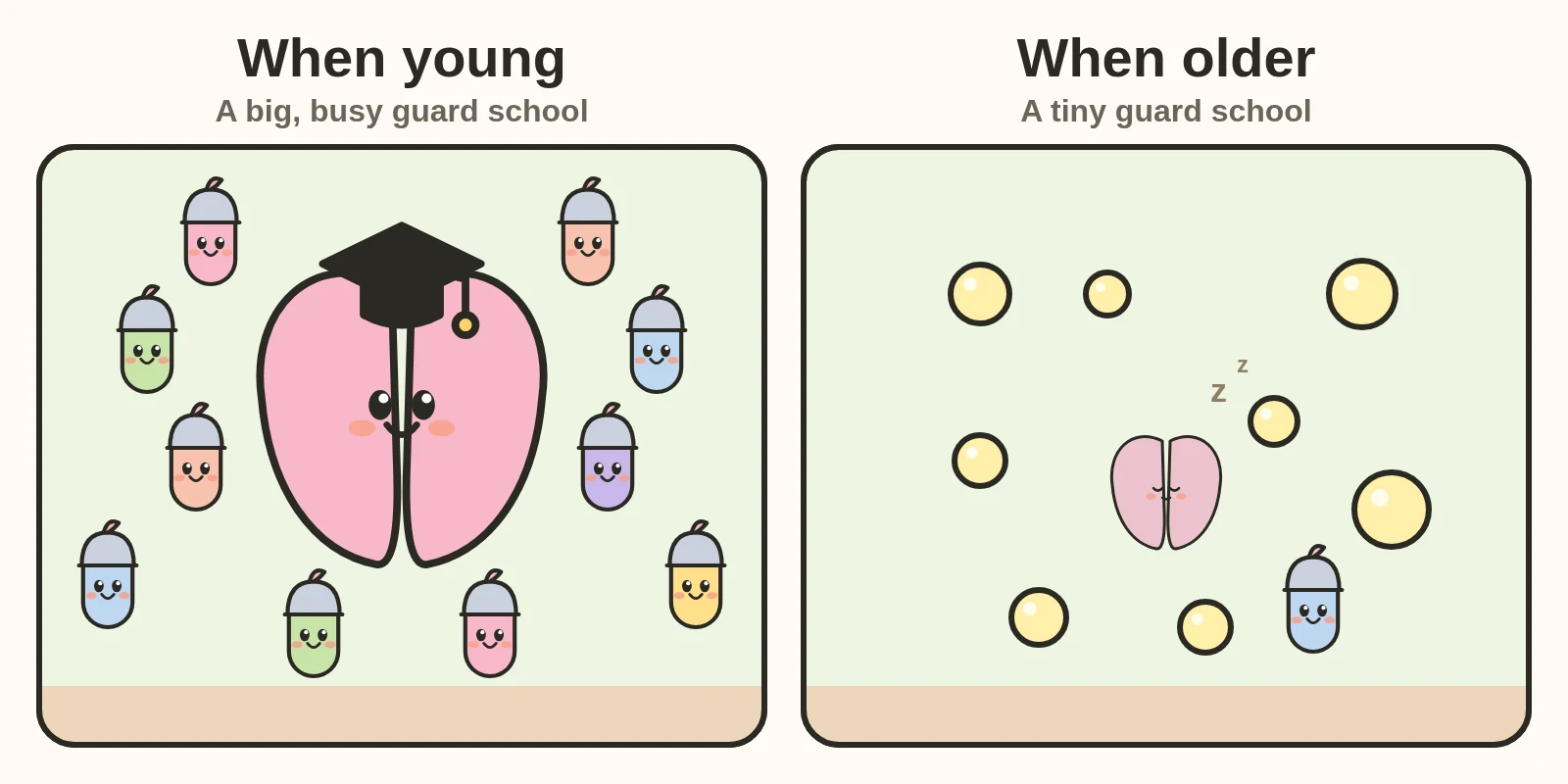
The older guards don’t just slow down. Many get a little jumpy, keeping a low, steady alarm ringing even when there’s no invader. Researchers named this “inflammaging” (in-flam-AY-jing).2
These changes are part of why people 65 and older face a higher risk of serious flu complications, which the CDC links in part to changing immune defenses with age.3
Scientists are now studying why the thymus shrinks and whether that quiet alarm can be turned down.
References
- Palmer DB. “The effect of age on thymic function.” Frontiers in Immunology 4: 316 (2013). doi:10.3389/fimmu.2013.00316
- Franceschi C, et al. “Inflamm-aging: An evolutionary perspective on immunosenescence.” Annals of the New York Academy of Sciences 908: 244–254 (2000). doi:10.1111/j.1749-6632.2000.tb06651.x
- CDC. “Flu and People 65 Years and Older.” cdc.gov/flu/highrisk/65over.htm
What this is not. Education only. Stories on cells.com are not medical advice. cells.com does not diagnose, treat, prescribe, run laboratory tests, or ship kits.
Simon Ng is the founder of cells.com. He has spent more than a decade on biotech finance executive teams, including at Quark Pharmaceuticals and Adverum Biosciences, and holds an MBA.