
The same recipe-card trick, aimed at cancer instead of a germ.
Yesterday we saw how an mRNA vaccine hands your cells a wanted poster for a virus. Can it work for cancer?
Cancer cells carry typos in their DNA. Some typos make odd proteins called neoantigens (NEE-oh-AN-tih-jenz) that the immune system could learn to spot.1
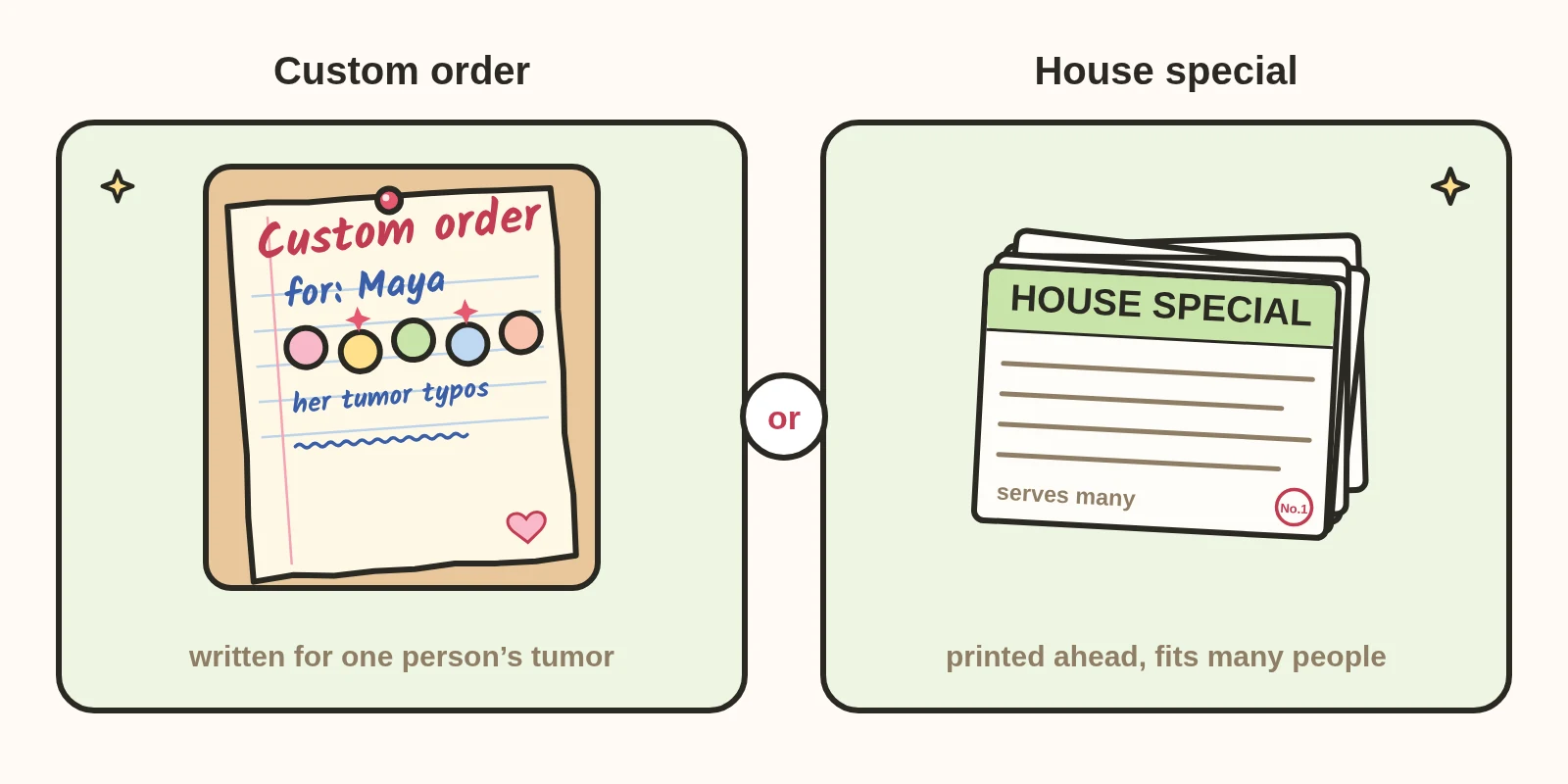
Custom order. Scientists read one person’s tumor, pick its typos, and write a recipe card just for them. In a mid-size melanoma trial, adding a personalized mRNA vaccine to immunotherapy was linked to fewer cancers returning compared with immunotherapy alone.2 A small pancreatic cancer study saw strong immune responses in about half of patients.3
House special. Other vaccines target proteins many tumors share, so one recipe could fit many people without being made one at a time.1
Both are still being tested. Next week, we dig deeper.
References
- Lorentzen CL, Haanen JB, Met Ö, Svane IM. “Clinical advances and ongoing trials on mRNA vaccines for cancer treatment.” Lancet Oncology 23:e450–e458 (2022). https://doi.org/10.1016/S1470-2045(22)00372-2
- Weber JS et al. “Individualised neoantigen therapy mRNA-4157 (V940) plus pembrolizumab versus pembrolizumab monotherapy in resected melanoma (KEYNOTE-942): a randomised, phase 2b study.” The Lancet 403:632–644 (2024). https://doi.org/10.1016/S0140-6736(23)02268-7
- Rojas LA et al. “Personalized RNA neoantigen vaccines stimulate T cells in pancreatic cancer.” Nature 618:144–150 (2023). https://doi.org/10.1038/s41586-023-06063-y
What this is not. Education only. Stories on cells.com are not medical advice. cells.com does not diagnose, treat, prescribe, run laboratory tests, or ship kits.
Simon Ng is the founder of cells.com. He has spent more than a decade on biotech finance executive teams, including at Quark Pharmaceuticals and Adverum Biosciences, and holds an MBA.