
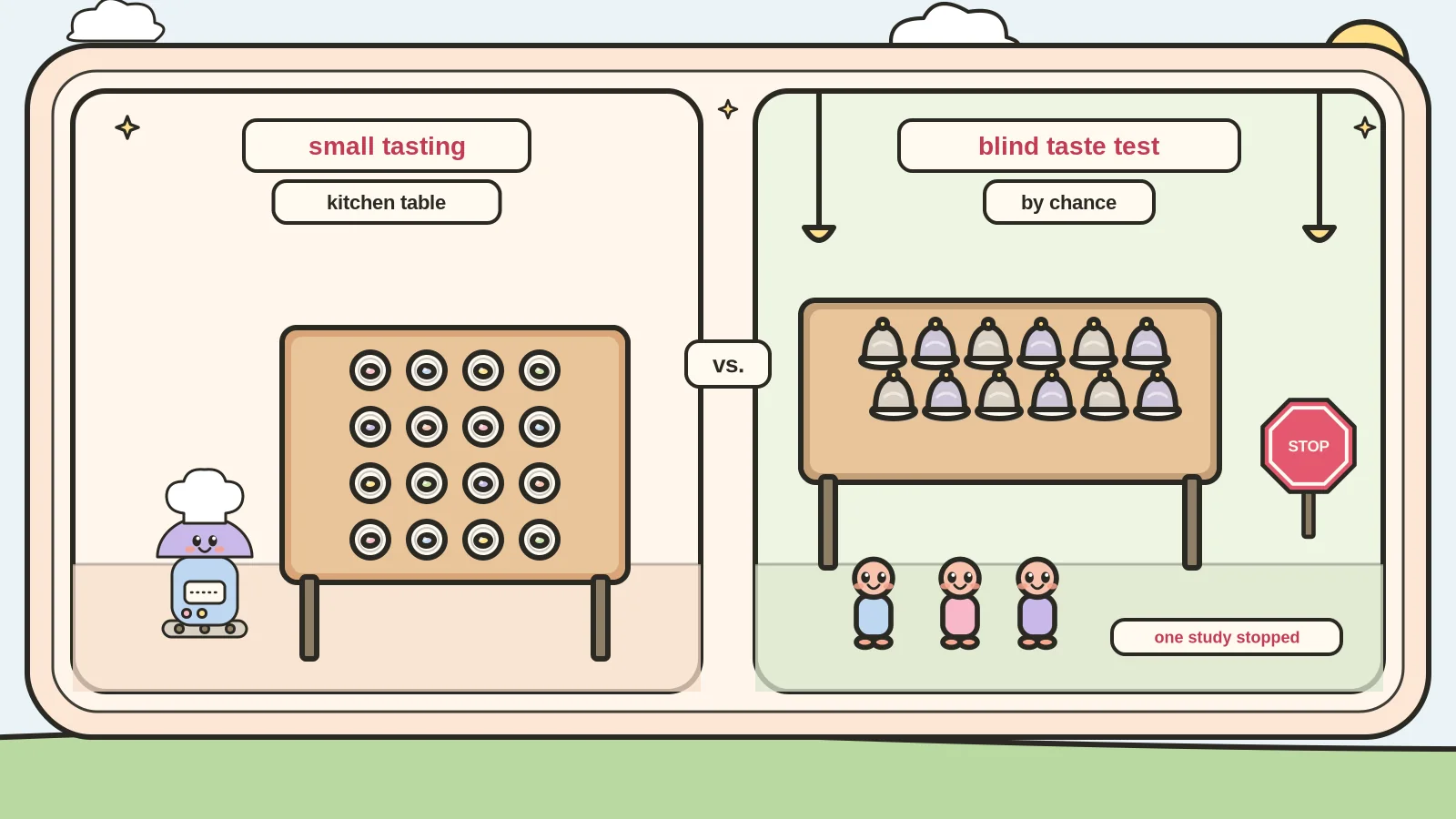
An early result is a good question, not a final answer. This year, the trials went different ways.
Try a new recipe on 16 friends at your kitchen table and you learn it’s edible. To learn if it’s really better, you need a big blind taste test: lots of tasters, plates handed out by chance, and the usual dish right beside it.
Early studies are the kitchen table. They ask: can it be made, is it safe, does the immune system respond? Randomized (RAN-duh-mized) studies are the taste test. Chance decides who gets the vaccine and who gets the usual care or a placebo (pluh-SEE-boh).
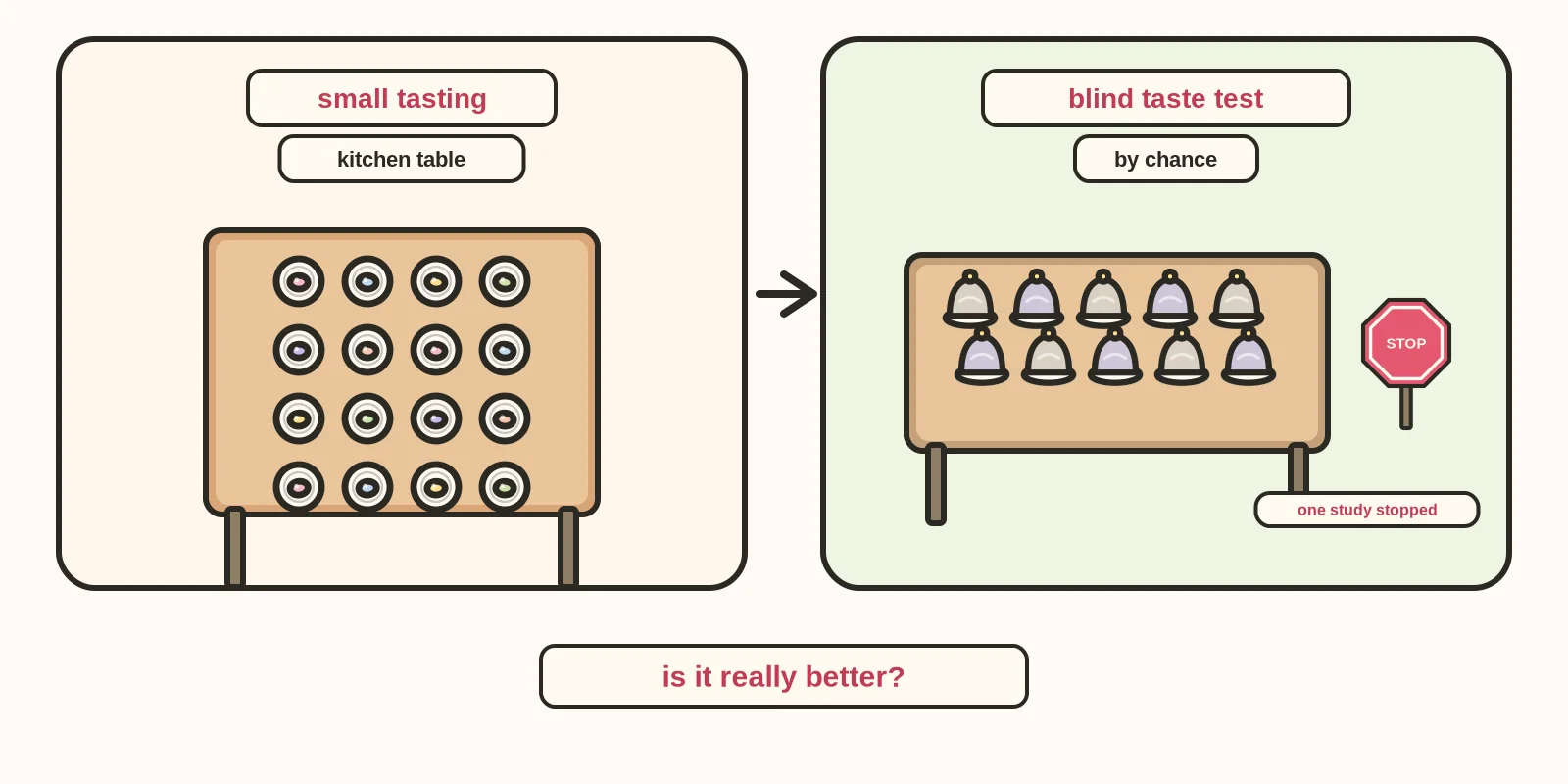
In melanoma, a randomized study of 1,137 people reported fewer cancer returns, called recurrence (ree-KUR-ens), when a personalized vaccine was added to a usual immunotherapy. The difference showed up after about six months, and it is still too early to say whether people live longer.1,2 In colorectal cancer, a randomized study was stopped in August 2026 after an independent review of early results.3 In the small pancreatic study from yesterday, people whose immune systems responded did better, but that is a link, not proof.4
All of these are trials, not treatments.
Tomorrow: the Weekly Recap.
References
- Long GV et al. “Intismeran Autogene plus Pembrolizumab for Resected Stage IIB to IV Melanoma.” New England Journal of Medicine (2026). https://doi.org/10.1056/NEJMoa2609762
- The ASCO Post, “High-risk melanoma: personalized mRNA vaccine plus immunotherapy reduces risk of recurrence after surgery” (Oct 2026). https://ascopost.com/news/october-2026/high-risk-melanoma-personalized-mrna-vaccine-plus-immunotherapy-reduces-risk-of-recurrence-after-surgery/
- BioNTech, “BioNTech Provides Update on Phase 2 Clinical Trial of Autogene Cevumeran in Resected Colorectal Cancer” (Aug 2026). https://www.biontech.com/us/en/home/mediaroom/news/statements/2026/08/BioNTech-Provides-Update-on-Phase-2-Clinical-Trial-of-Autogene-Cevumeran-in-Resected-Colorectal-Cancer.html
- Sethna Z et al. “RNA neoantigen vaccines prime long-lived CD8+ T cells in pancreatic cancer.” Nature 639:1042–1051 (2025). https://doi.org/10.1038/s41586-024-08508-4
What this is not. Education only. Stories on cells.com are not medical advice. cells.com does not diagnose, treat, prescribe, run laboratory tests, or ship kits.