
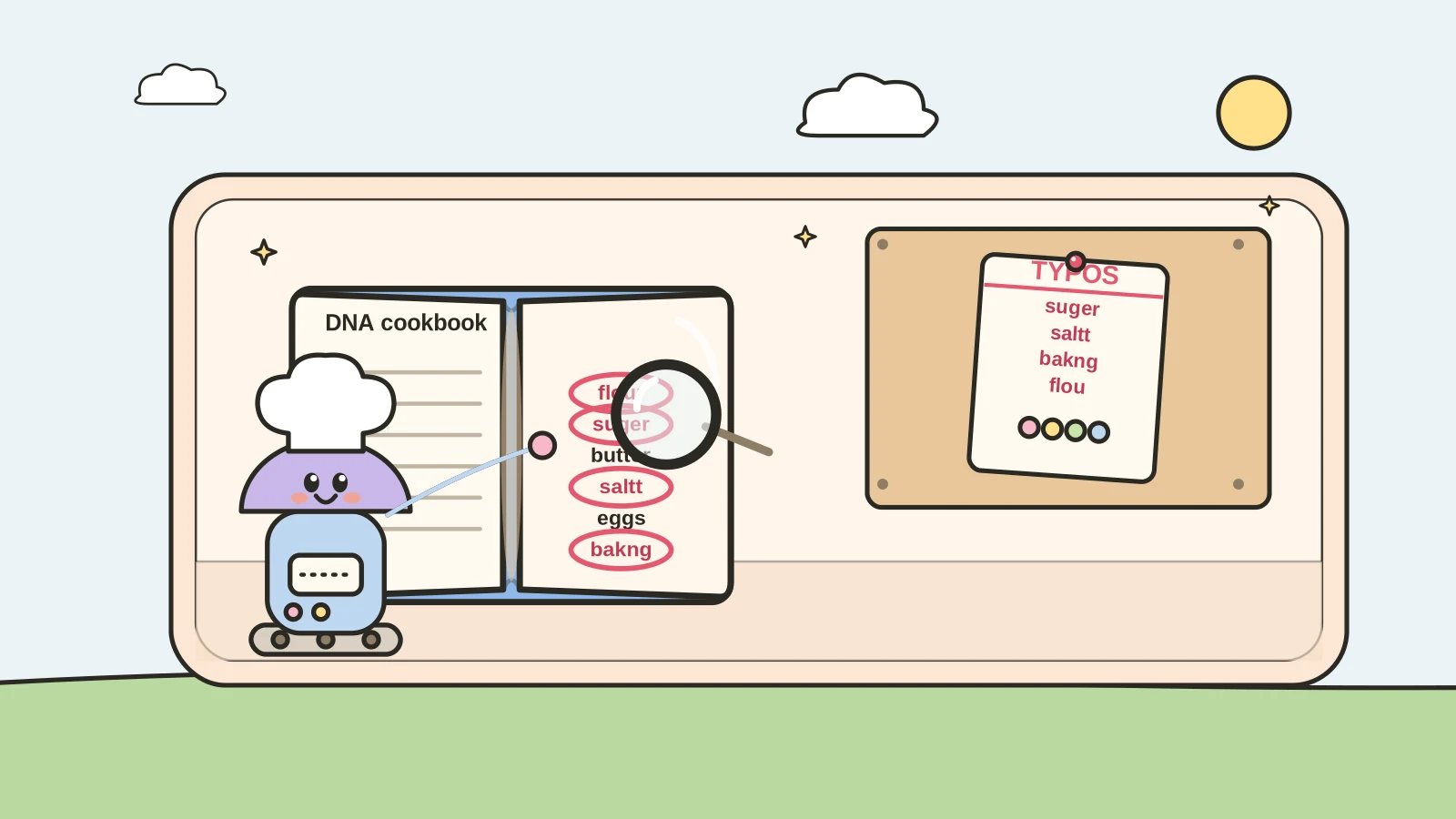
Every tumor has its own spelling mistakes. Some give researchers clues for a personalized vaccine.
Think of DNA as a cell’s cookbook. When cells copy it, typos can slip in. These changes are called mutations (myoo-TAY-shunz). Tumors often carry many of them.1
Some typos change a protein, creating a piece the immune system may recognize as unfamiliar. These pieces are called neoantigens (NEE-oh-AN-tih-jenz). Think of them as little flags that help distinguish a tumor from healthy cells.1
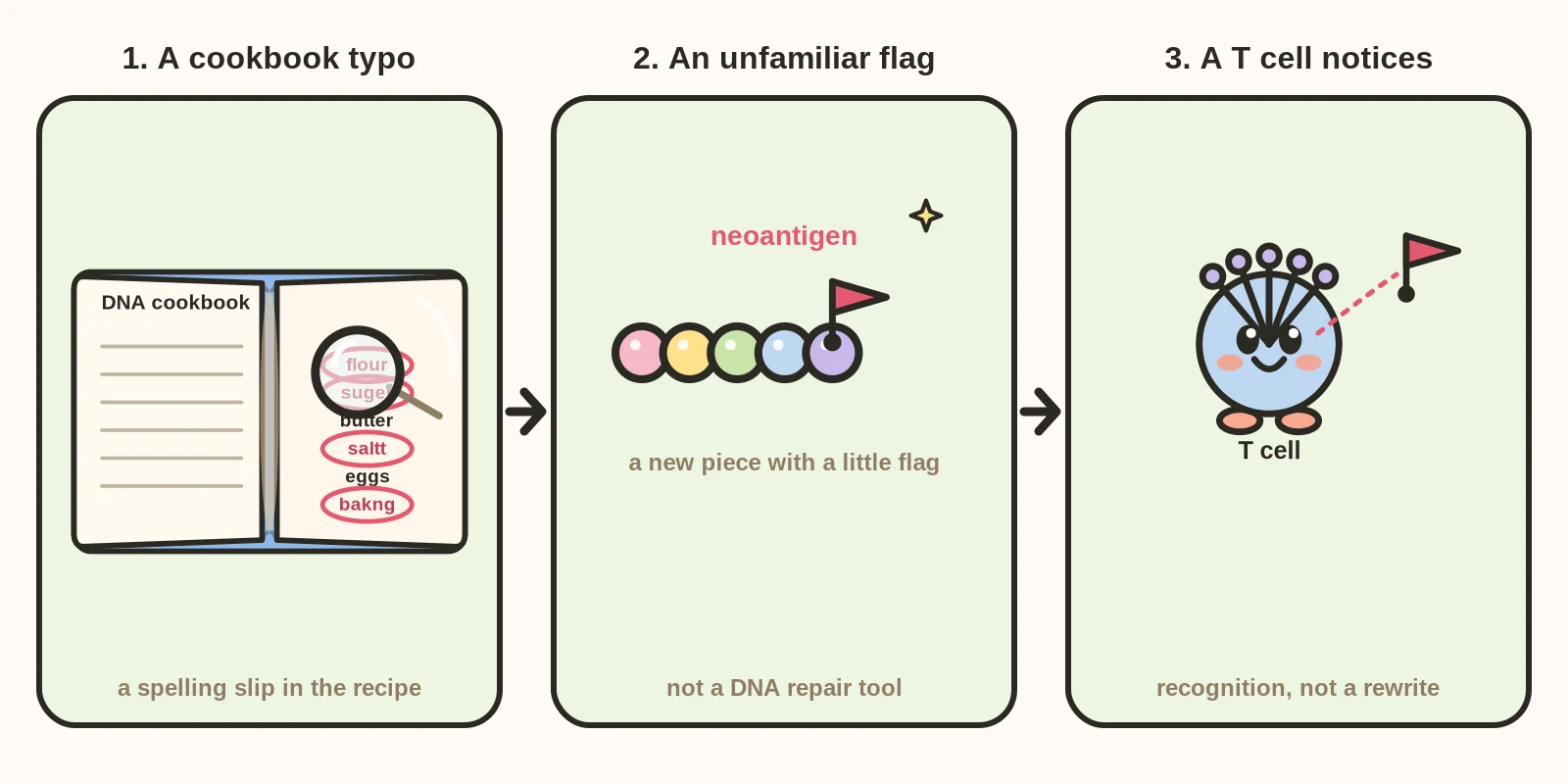
Researchers compare a person’s tumor DNA with their healthy DNA, then choose changes that might make useful targets. A personalized mRNA vaccine carries instructions for making selected pieces, helping teach T cells (TEE sells) what to recognize.2
The cookbook analogy has a limit: the vaccine doesn’t erase the typos or repair the DNA. It aims to help the immune system recognize cells carrying those flags. These vaccines are still being studied in clinical trials, and they don’t work for everyone.
Tomorrow: how a recipe card gets made for one patient.
References
- Schumacher TN, Schreiber RD. “Neoantigens in cancer immunotherapy.” Science 348:69–74 (2015). https://doi.org/10.1126/science.aaa4971
- Sahin U et al. “Personalized RNA mutanome vaccines mobilize poly-specific therapeutic immunity against cancer.” Nature 547:222–226 (2017). https://doi.org/10.1038/nature23003
What this is not. Education only. Stories on cells.com are not medical advice. cells.com does not diagnose, treat, prescribe, run laboratory tests, or ship kits.