
The same vaccine idea is being tried in very different cancers. The pancreas story is much earlier.
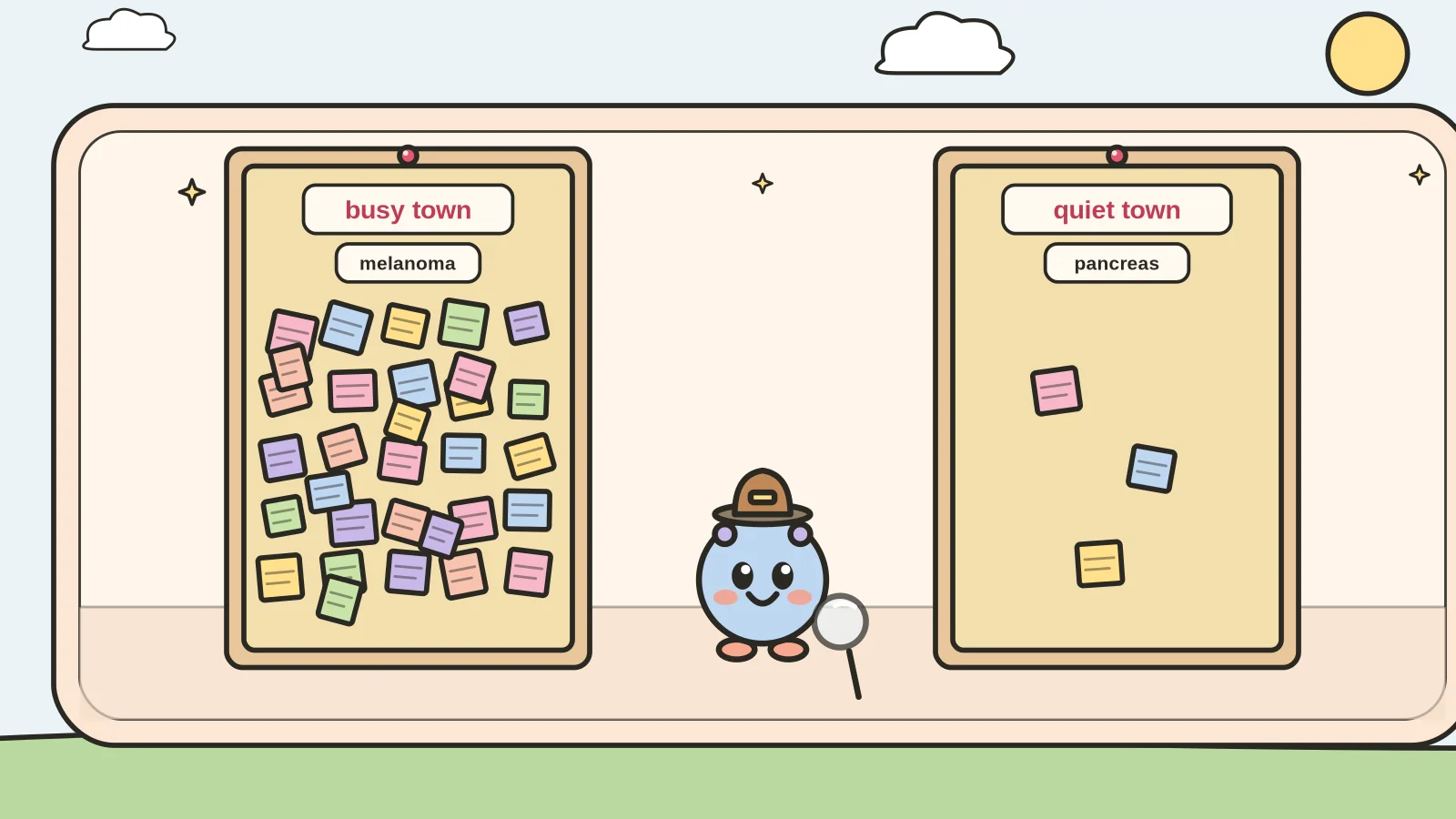
Picture wanted posters in two towns. In a busy town, witnesses give dozens of clues. In a quiet town, there are only a few. Melanoma (mel-uh-NOH-muh), a skin cancer, is like the busy town: its tumors usually carry many DNA typos. Pancreatic (PAN-kree-AT-ik) tumors usually carry fewer.1 The open question: are a few clues enough for the immune system to spot the suspect?
In melanoma, the work has gone further. Larger studies that compare people by chance have already reported results, including one presented in October 2026 and now published as a journal paper.5 We will look at those findings tomorrow.
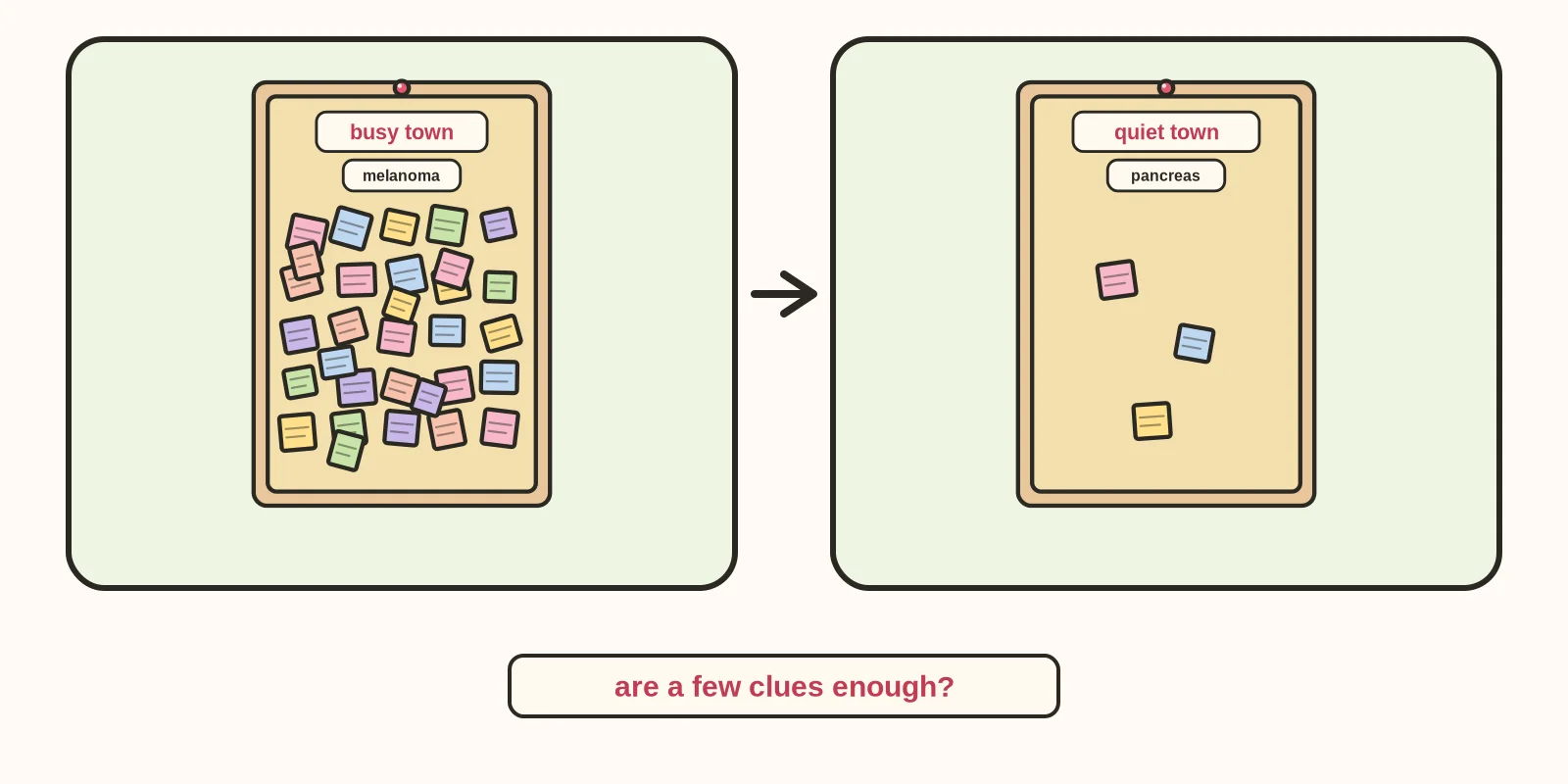
In pancreatic cancer, the work is still small and early. In one study at a single hospital, 16 people got a personalized vaccine after surgery. About half made new immune cells aimed at their tumor’s typos, and researchers are following them over time.2,3 That study had no comparison group, so it can’t show the vaccine is why anyone did well. A larger randomized study, comparing people by chance, is now underway, with main results expected around 2031.4
These vaccines are still being studied in clinical trials.
Tomorrow: small tastings vs. a big blind taste test.
References
- Alexandrov LB et al. “Signatures of mutational processes in human cancer.” Nature 500:415–421 (2013). https://doi.org/10.1038/nature12477
- Rojas LA et al. “Personalized RNA neoantigen vaccines stimulate T cells in pancreatic cancer.” Nature 618:144–150 (2023). https://doi.org/10.1038/s41586-023-06063-y
- Sethna Z et al. “RNA neoantigen vaccines prime long-lived CD8+ T cells in pancreatic cancer.” Nature 639:1042–1051 (2025). https://doi.org/10.1038/s41586-024-08508-4
- ClinicalTrials.gov, NCT05968326 (status checked Nov 11, 2026: active, not recruiting; primary completion estimated 2031). https://clinicaltrials.gov/study/NCT05968326
- Long GV et al. “Intismeran Autogene plus Pembrolizumab for Resected Stage IIB to IV Melanoma.” New England Journal of Medicine (2026). https://doi.org/10.1056/NEJMoa2609762
What this is not. Education only. Stories on cells.com are not medical advice. cells.com does not diagnose, treat, prescribe, run laboratory tests, or ship kits.