
Your DNA is the cookbook. mRNA is the recipe card that gets the cooking done.
Picture your DNA as a giant cookbook locked in the library at the center of each cell, the nucleus (NOO-klee-us). It holds the recipes for every protein your body makes, but the book never leaves the room.
So the cell copies one recipe at a time onto a little card. That card is messenger RNA, or mRNA (em-ARR-en-ay). Making the copy is called transcription (tran-SKRIP-shun).1
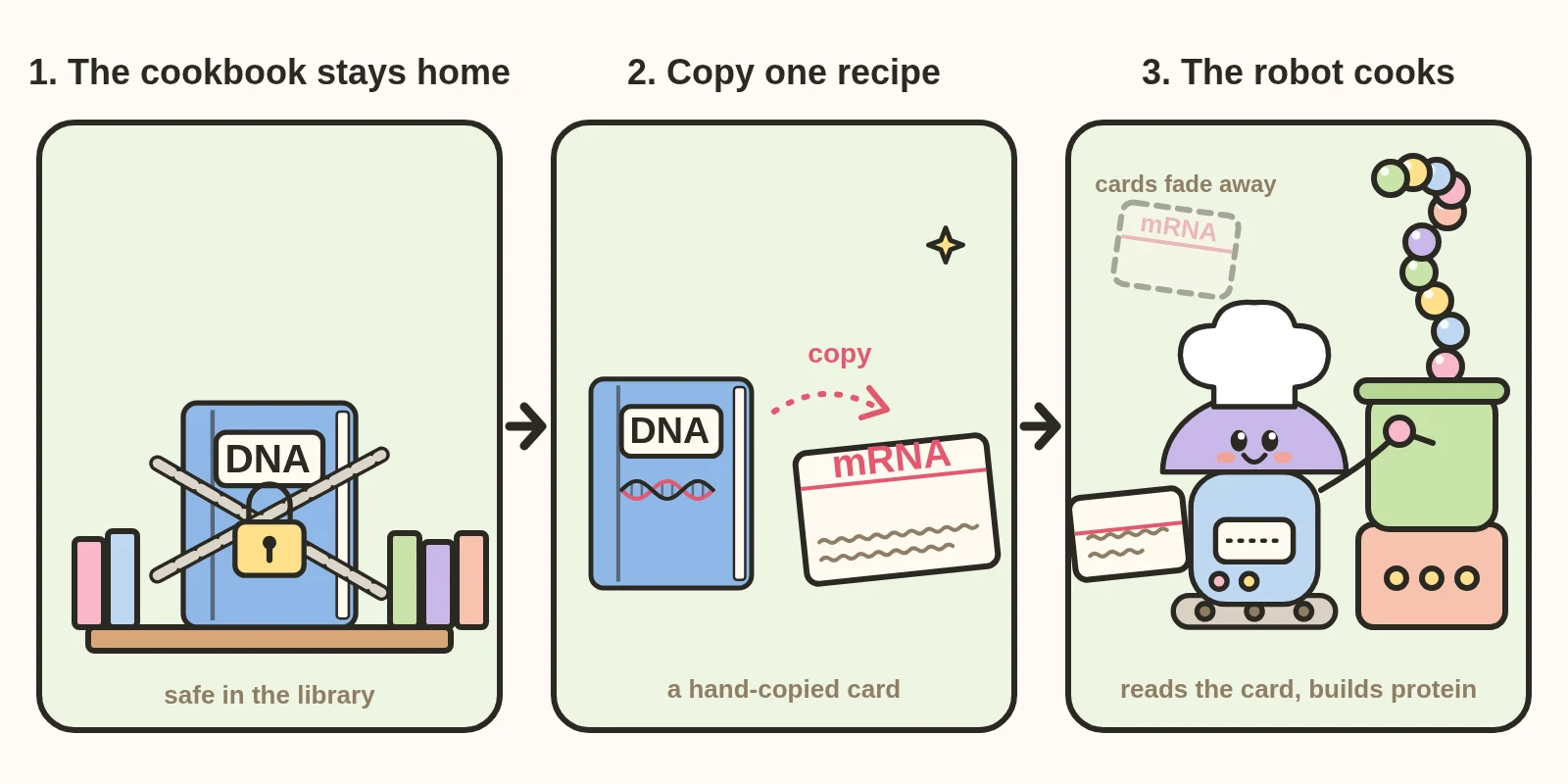
The card travels out into the cell’s watery kitchen. There, a tiny cooking machine called a ribosome (RY-buh-zome) reads it three letters at a time and strings together building blocks called amino acids into a protein.2
Here’s the clever part: the cards don’t last. Cells read them, then break them down, so the cookbook stays safe and the kitchen only cooks what it needs right now.3
Your cells do this all day, every day, your whole life long. Tomorrow: how scientists borrowed these recipe cards for vaccines.
References
- National Human Genome Research Institute. “Messenger RNA (mRNA).” Talking Glossary of Genomic and Genetic Terms. https://www.genome.gov/genetics-glossary/messenger-rna
- National Human Genome Research Institute. “Ribosome.” Talking Glossary of Genomic and Genetic Terms. https://www.genome.gov/genetics-glossary/Ribosome
- Wu X, Brewer G. “The regulation of mRNA stability in mammalian cells: 2.0.” Gene 500: 10–21 (2012). doi:10.1016/j.gene.2012.03.021
What this is not. Education only. Stories on cells.com are not medical advice. cells.com does not diagnose, treat, prescribe, run laboratory tests, or ship kits.
Simon Ng is the founder of cells.com. He has spent more than a decade on biotech finance executive teams, including at Quark Pharmaceuticals and Adverum Biosciences, and holds an MBA.