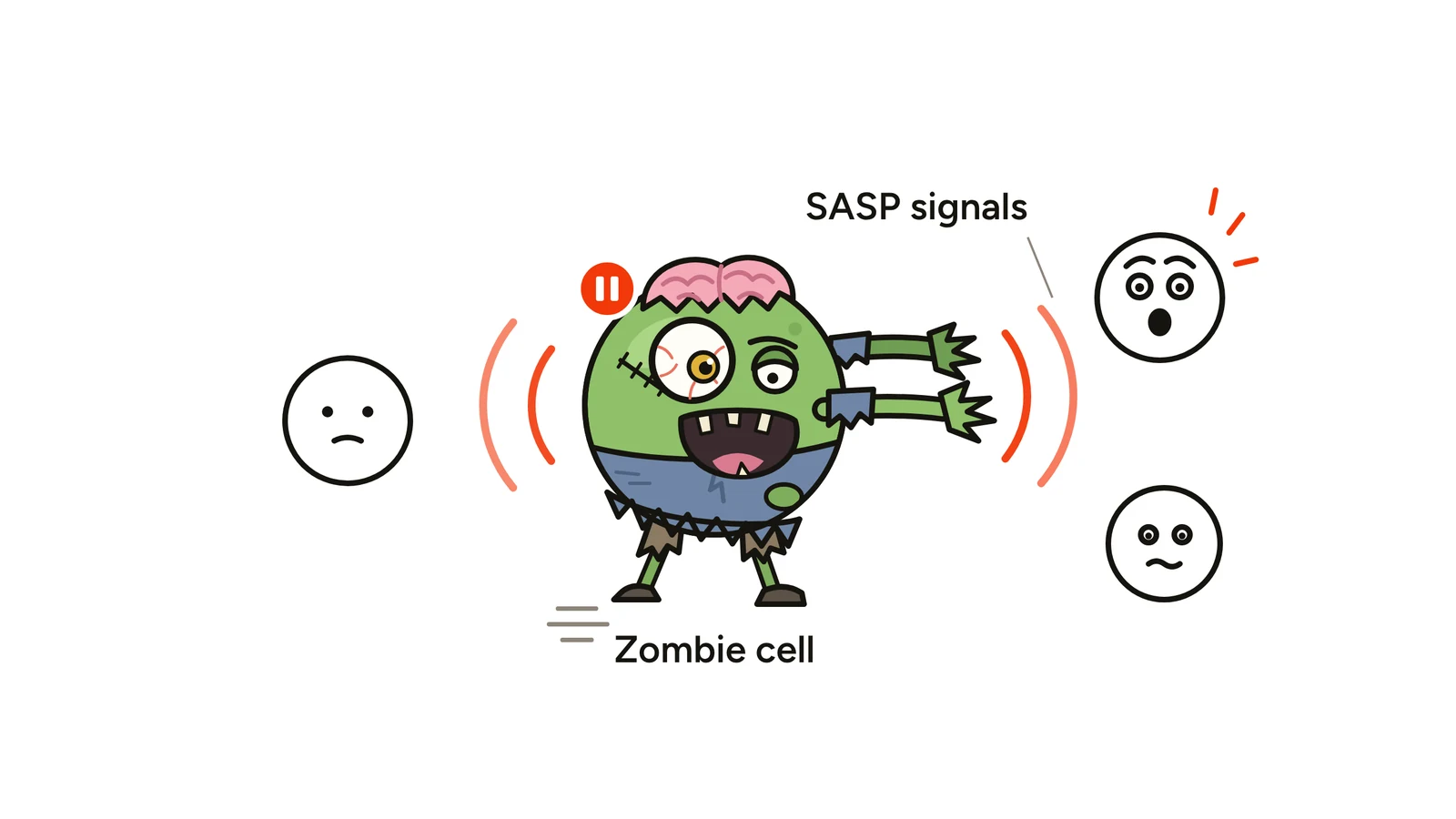
Picture a coworker who stopped working years ago but still shows up every day, complaining loudly. Your body has cells a bit like that.
Most cells divide to replace themselves. But when a cell gets stressed or damaged, or its telomeres run short, it can hit the brakes for good. This is called cellular senescence (suh-NESS-unce). The cell stops dividing, yet it doesn’t die. That’s why scientists nickname them “zombie cells.”
In small doses, this is helpful. Pausing a damaged cell keeps it from copying its mistakes, and senescent cells help with things like wound healing.1
The trouble starts when they pile up. Zombie cells send out a stream of chemical signals called the SASP (say it “sass-P”), short for senescence-associated secretory phenotype. Those signals can stir up inflammation in nearby tissue, like one smoke alarm setting off the whole building.
Scientists list senescence as one of the hallmarks of aging.1 NIH even funds a project to map where these cells live in the body.2 It’s one clue among many, not the whole story.
References
- López-Otín C, Blasco MA, Partridge L, Serrano M, Kroemer G. “Hallmarks of aging: An expanding universe.” Cell 186 (2023): 243–278. doi:10.1016/j.cell.2022.11.001
- NIH Common Fund, “Cellular Senescence Network (SenNet)”: https://commonfund.nih.gov/senescence
What this is not. Education only. Stories on cells.com are not medical advice. cells.com does not diagnose, treat, prescribe, run laboratory tests, or ship kits.
Simon Ng is the founder of cells.com. He has spent more than a decade on biotech finance executive teams, including at Quark Pharmaceuticals and Adverum Biosciences, and holds an MBA.