
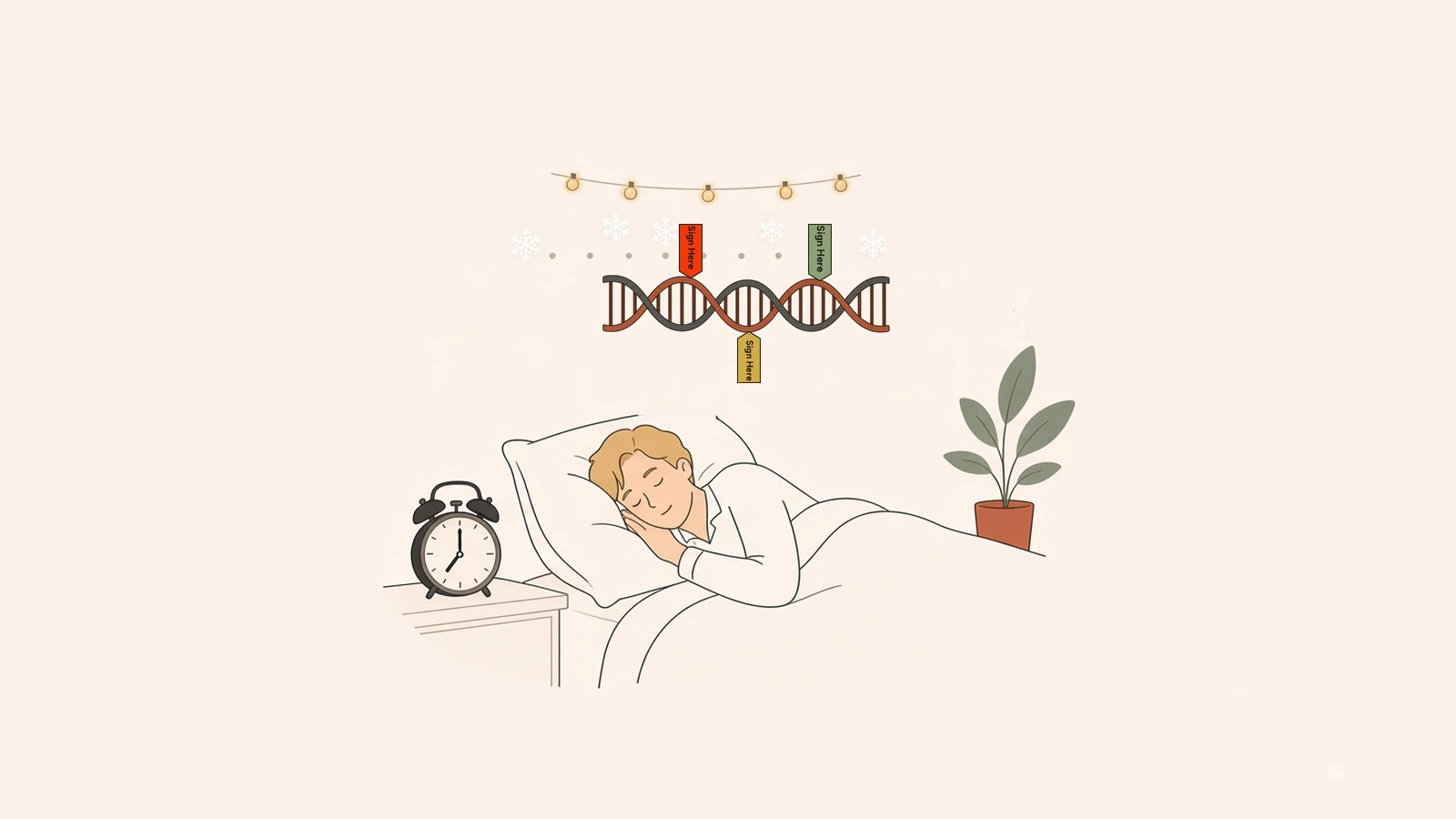
This week we met two kinds of body clocks, and learned they are not the same thing.
Bookmarks in Your Cookbook (Nov 16)
Tiny tags on DNA, called methylation (meth-uh-LAY-shun), act like bookmarks. Clocks such as GrimAge give an age in years. DunedinPACE (duh-NEE-din pace) works more like a speedometer.
Read it
Which Bookmarks, and How We Read Them (Nov 17)
Similar names, different tests. Ask what the number estimates, which clock made it, what sample was used, and how much it could wobble.
Read it
The Kitchen's Opening Hours (Nov 18)
Your circadian (sur-KAY-dee-un) clock keeps time of day. It is not the epigenetic clock from Monday.
Read it
Did Sleep Make Anyone Younger? (Nov 19)
Two studies found links, pointing in different directions. Neither showed that sleep turns a clock back.
Read it
Who's researching this
The Dunedin Study at the University of Otago (uh-TAH-go), New Zealand, has followed 1,037 people from Dunedin for about 50 years. At the age-45 check-in, 94% of living members took part. Data from this group helped build DunedinPACE. It is an academic study, not a company selling tests. (Dunedin Study; eLife 2022)
Mentioning a group is not an endorsement or medical advice.
References
- Dunedin Multidisciplinary Health & Development Study, official site: https://dunedinstudy.otago.ac.nz/
- Belsky DW et al. “DunedinPACE, a DNA methylation biomarker of the pace of aging.” eLife 11:e73420 (2022): https://doi.org/10.7554/eLife.73420
What this is not. Education only. Stories on cells.com are not medical advice. cells.com does not diagnose, treat, prescribe, run laboratory tests, or ship kits.